Exploring the lived-in showroom
Text by Gerald Kozicz
Archival material for the reconstruction of the lived-in showroom which the Skušeks created is limited. They lived in at least three different places during their years together in Ljubljana with the collection they brought from China. Several photographs, some of which are clearly staged, and a movie allow some insight into the design and also functionality of the various objects.
2-minute short film showing Tsuneko in her apartment, Uploaded to Youtube by Slovene Ethnographic Museum © Filmske novosti Beograd, 1957
Especially the movie, produced in 1957 when Tsuneko was already widowed, displays how small the spaces and how dense the arrangement must have been. Among all the various objects and sets, a dresser with Buddhist sculptures placed on it, stands out. One of the non-staged photographs depicts Tsuneko visited by a friend having tea or coffee in front of that dresser.
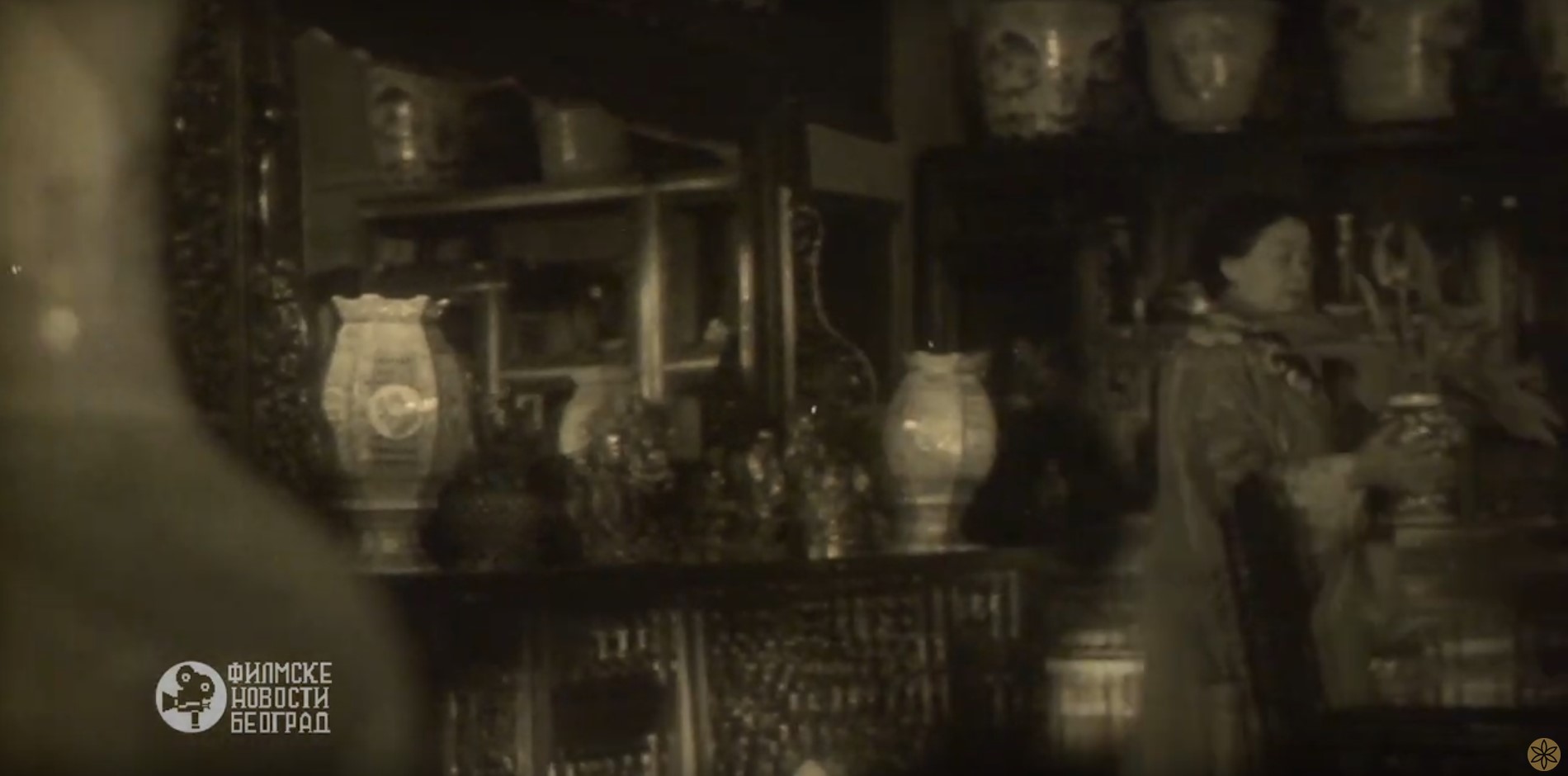
Tsuneko next to the dresser, Screenshot by Gerald Kozicz © Filmske novosti Beograd, 1957

Close-up shot of the dresser displaying the sculptures, Screenshot by Gerald Kozicz © Filmske novosti Beograd, 1957
When the couple exhibited some of their collection at the 1930 Ljubljana Grand Fair, it was again that configuration of dresser and Buddhist images which was displayed. It is well documented on photographs, one of which shows Tsuneko‘s daughter Erika dressed in an original Chinese costum playing the lute, probably taken at the Fair. (Kozicz, Luo, Frühwirt 2025: 97, fig. 4; cf. Berdajs 2021: 164, fig. 10) The figurines were certainly among the most impressive objects, but it seems that they were also of specific personal importance to Tsuneko. The mode of display and also the order of arangement, which remains widely unchanged through the years, suggest that they functioned as a personal reminder of her early life in Japan and China, or even more than that: a personal shrine.
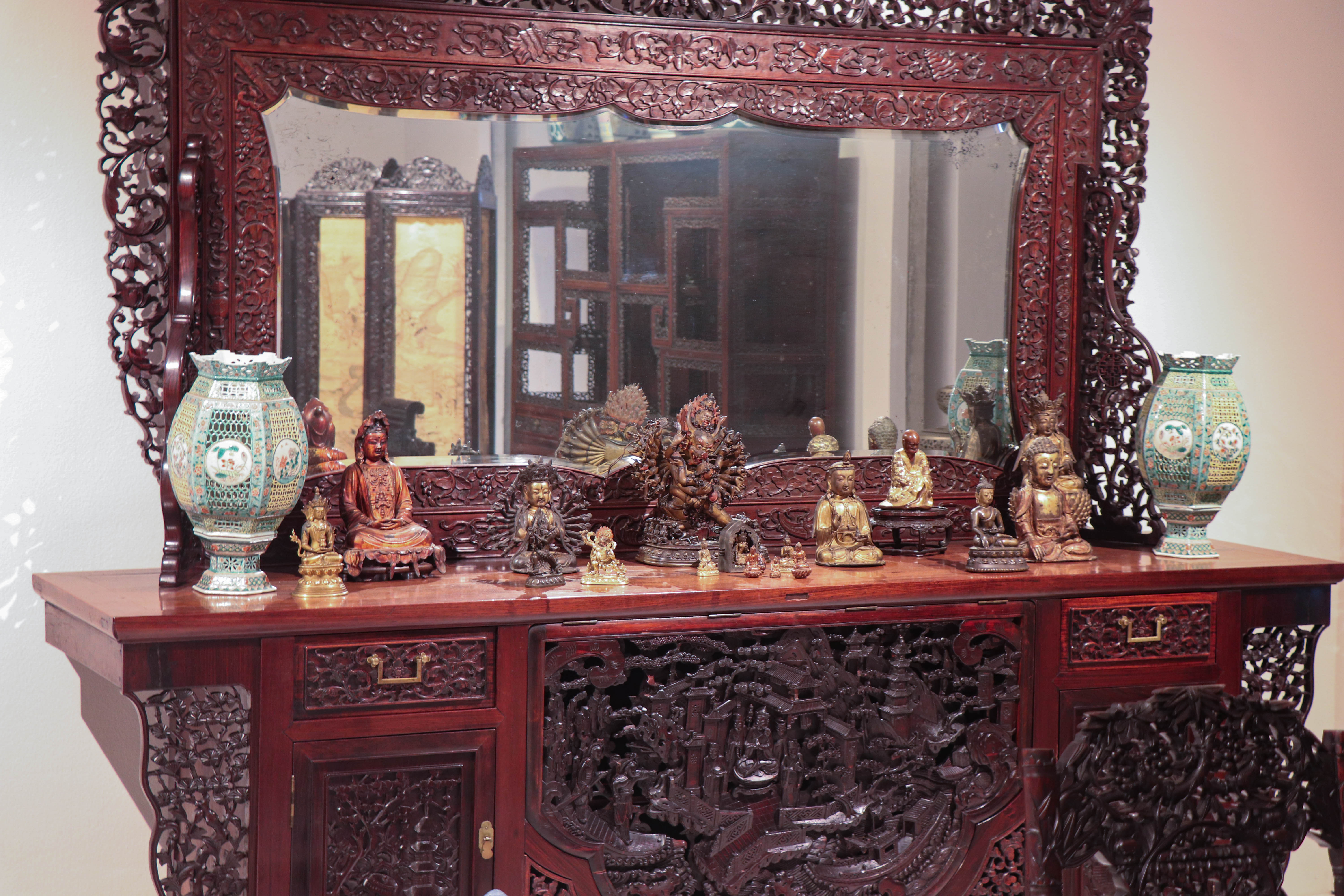
Dresser being exhibited during the 2025 exhibition “Asia in the Heart of Ljubljana: The Life of the Skušek Collection” at the Slovene Ethnographic Museum, Photograph © Max Frühwirt 2025
Choosing the dresser and the sculptures, of which the majority are bronzes, as the core of the virtual showroom is a logical step. We also aim to include the table, which is not only shown on photographs but also presented centrally in the 1957 movie to visualise also the ambiguity of the original constellation and the different functionalities which the space could be adjusted to.
References
Berdajs, Tina (2021) ‘Retracing the Footsteps: Analysis of the Skušek Collection’, Asian Studies 9, no. 3: 141–166. Open access URL https://journals.uni-lj.si/as/issue/view/739
Filmske novice 1: Zanimiva zbirka. Avtor Vladimir Perišić, © Filmske novosti Beograd,1957. https://www.youtube.com/watch?v=tFDnA8UzBr0
Kozicz Gerald, Di Luo and Max Frühwirt (2025) ‘The Naval Officer and the Kimonoed Lady’, Orientations Vol. 56, No. 2: 94–99.