The Eighteen-armed Goddess
Text by Gerald Kozicz
One of the enigmatic figures on the dresser in the Skušek‘s flat is an eighten-armed bronze in sitting posture with both legs crossed. Its pedestal is apparently gone. The figure was labelled as Kuanyin, that is, the Bodhisattva of Compassion Avalokiteśvara, in an early inventory list produced after the transfer of the collection to the SEM. The sculpture however, depicts the goddess Cundā (also Cundī). This “misidentification” is not unique as several almost identical sculptures across European museum collections are labelled as the male bodhisattva. In fact, nothing would hint at a female deity as no physical features display her feminine nature. Also, the central pair of hands displays a gesture that is almost identical with Avalokiteśvara‘s hands that hold the invisible wish-granting jewel in front of the chest.
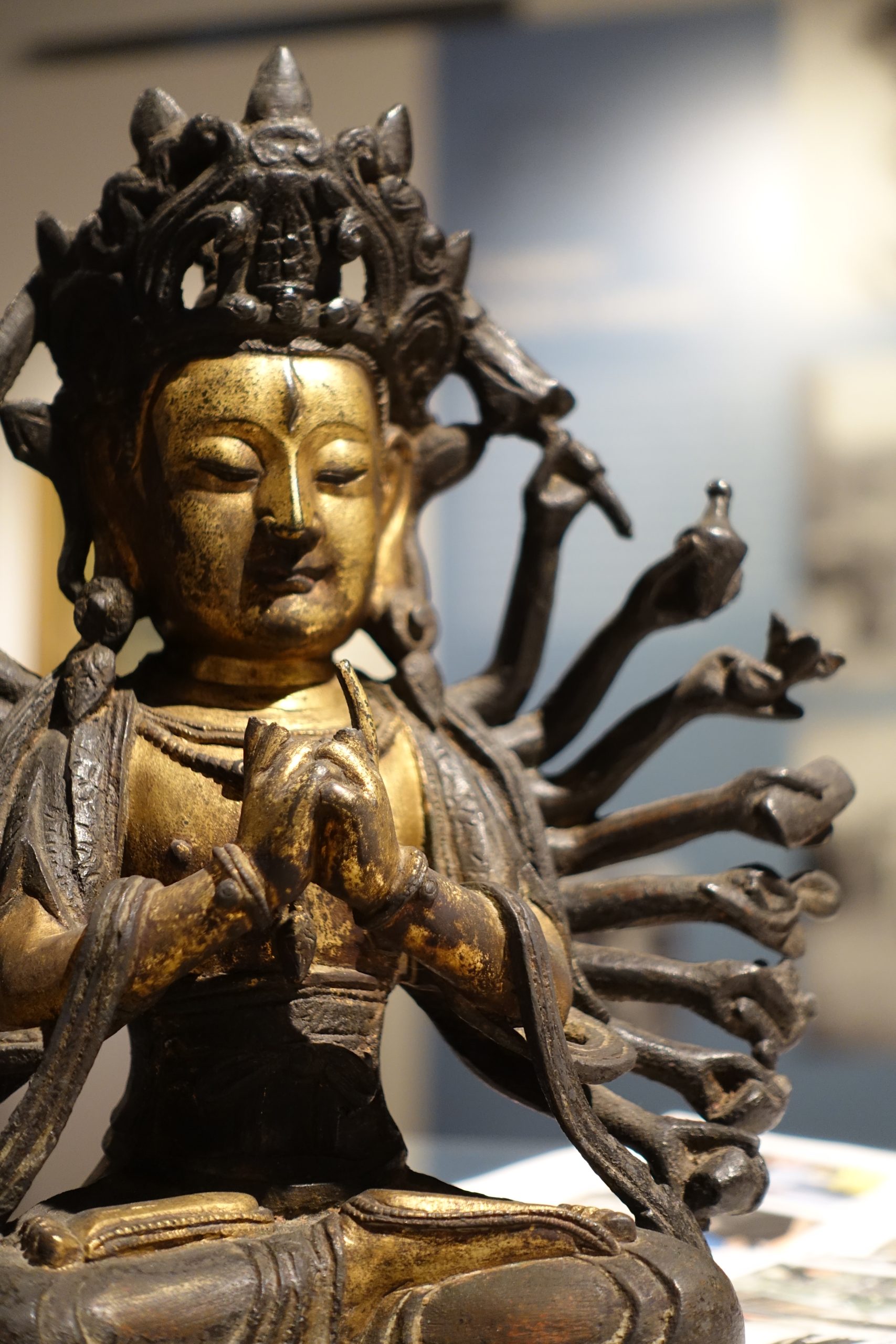
Close-up of the Cunda sculpture with its broken-off fingers, Photograph © Gerald Kozicz, 2024
The wide-spread labelling of her depictions as Avalokiteśvara is still conspicious. Why would several trained art historians and curators make the same mistake? What appears like a confusion of identities based on misreading the details of the bronzes, might be the result of an adaption of the goddess – whose origin is of course rooted in Indian Buddhism – to a Chinese socio-religious environment. The reconstruction of the history of Cundā is not an easy taks. Originally she is considered a personification of a sacred spell (dhāraṇī) datable to the 6th-7th centuries. In this first textual appearance, she is called the mother of the seventy (seven hundred?) million buddhas (Jeff Watt 2021 with reference to the Kāraṇḍavyūhasūtra). The mantra itself also strongly relates to Avalokiteśvara. The two deities however, do not seem to be closely related in North Indian Buddhism during the late Mahāyāna and early Vajrayāna period which ended in Northern India in the early 13th century. Cundā is venerated as a protectress and remover of obstacles along the path towards enlightenment. While Avalokiteśvara‘s means of spiritual guidance focus on compassion, Cundā‘s primary weapon is apparently “wisdom”. This is expressed by the central gesture, the dharmacakra gesture (mudrā) which symbolises the Turning of the Wheel (cakra) of the Law (dharma). In this regard she very much resembles the personification of the Prajñāpāramitā, the Perfection of Wisdom, the fundamental text corpus of the Mahāyāna tradition. This text is deified as a goddess of the same name. The two goddesses overlap regarding their spiritual concepts and naturally share iconographic features, that is, the gesture and the book as the major attribute. Cundā‘s poularity enters a phase of decline by the end of the first millennium in Northern India and she is practically absent in Tibetan Buddhism which continues the Tantric Indian tradition after its collapse in its homeland. In contrast, she becomes very popular in East Asia, especially Japan where she prominently enters the esoteric pantheon of the Shingon tradition. And in China her eighteen-armed form regains significance in the Qing Dynasty of the Manchus. And this is the era to which the “misidentified” bronzes can be dated.
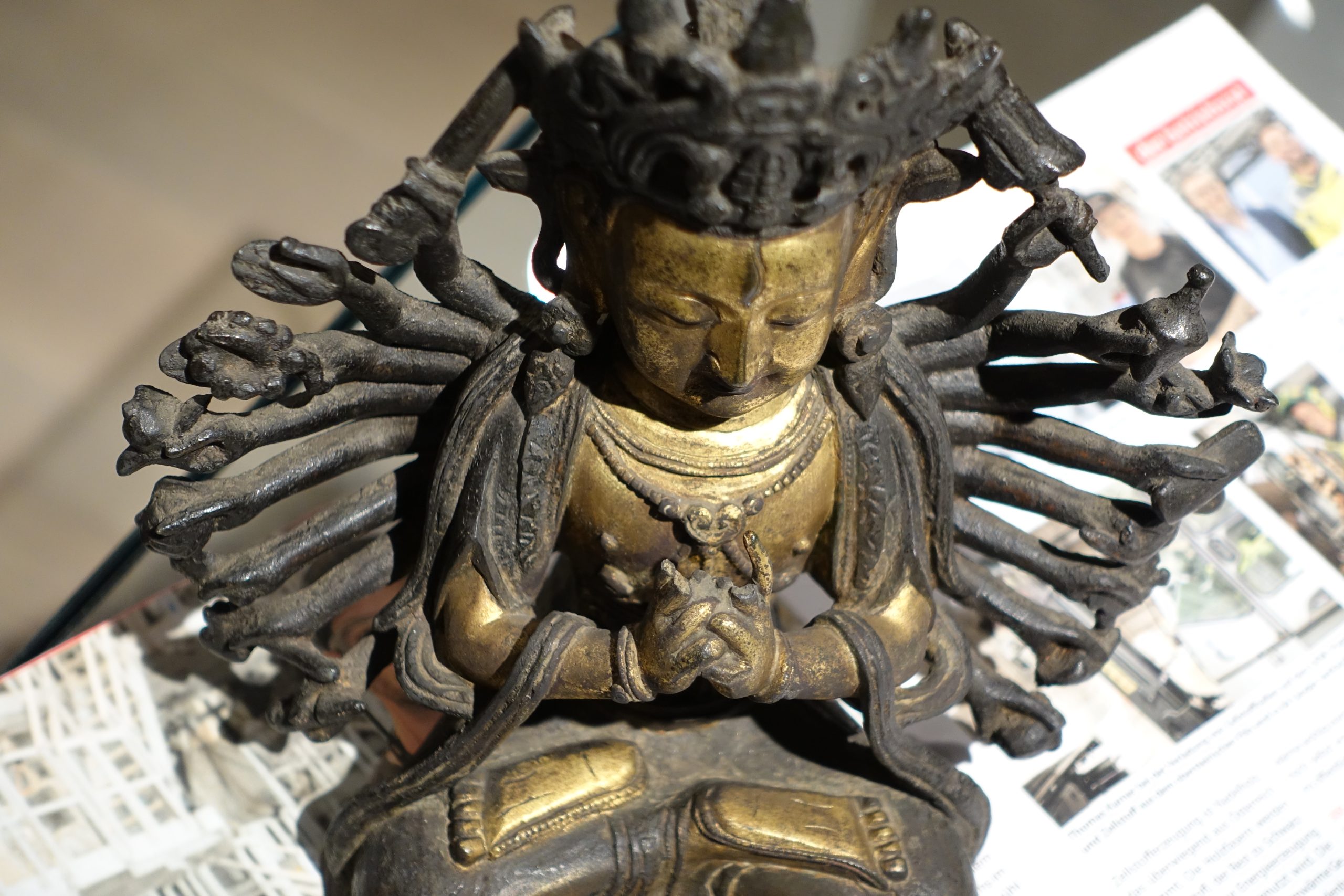
Cunda’s 18 arms displaying different attributes , Photograph © Gerald Kozicz, 2024
Why Cundā became popular again might have a simple reason. The Manchus like the Mongols of the Yuan Dynasty, understood themselves as warriors. Similar to their sympathy for Vajrabhairava, the iconography of a multi-armed deity with a full array of weapons might have appeared attractive to them. We may also recall the fact that Avalokiteśvara as Guanyin adopted a feminine notion probably in a reversed understanding of compassion as a female or rather a non-masculine feature.
How Cundā who is originally of peaceful nature, was exactly venerated during the Qing era has not yet been studied properly. Her placement among the wrathful deities on the dresser is however conspicious. As mentioned before, several collections in European display almost identical bronzes. The Skušek bronze displays some exceptional details still. The sixteen arms which form a kind of circle around the goddess are significantly thinner than the central pair. Also, only the central body and the central pair of hands were gilded. Thus, the sixteen arms do not appear like actual arms but rather like darks rays creating an aura made of weapons. Unfortunately, quite a number of the weapons have eroded or disappeared. Since no standardised list of weapons exists, we cannot reconstruct the original set of weapons and attributes. Some are very clear such as the sword, the book, the rosary and the flasks. Others can be identified tentatively at best.
Turntable of Cunda including visual representation of her symbols, Visualisation and Animation by Max Frühwirt, Drawings by Gerald Kozicz © 2025
Finally, the hand gesture is not identical with the dharmacakra mudrā any more. The fingers or the two hands are firmly hooked into each other like a knot while the forefinger – one of which is broken today – seemingly pointed upwards. The way Cundā is presented among the wrathful deities probably very well reflects how she was evoked and experienced during the late Qing era.
References
Beer, Robert (2003) The Handbook of Buddhist Symbols. Chicago – London: Serindia.
Chandra, Lokesh (2001) Dictionary of Buddhist Iconography, Vol. 3, 858-863. New Delhi: International Academy for Indian Culture.
Jeff Watt (2021) Chunda. Main Page. Himalayan Art Resources, https://www.himalayanart.org/search/set.cfm?setID=1159 [13.11.2025]