Disappeared from the Collection and Brought Back
Text by Gerald Kozicz
One of the archival, unfortunately not dated photographs from the Photographic Archive of the SEM shows the Buddhist sculptures from the collection on the dresser in front of the mirror. Vajrabhairava is in the central position but quite in the background. The low angle chosen by the unknown photographer directs the focus towards the smaller metalworks in the front. The old B/W image is clear but still the details are difficult to determine.
One of the figures appears to be the Vajrapani which is still in the collection and also shown in the exhibition. Several features are identical such as the aggressive posture with the right knee bent and the left extended. The hair is upright like a flame and the right arm is raised. The attribute held in that hand however, is not a vajra but a sword. The handle of the sword is slightly tilted which allows us to identify the deity with certainty: Begtse.
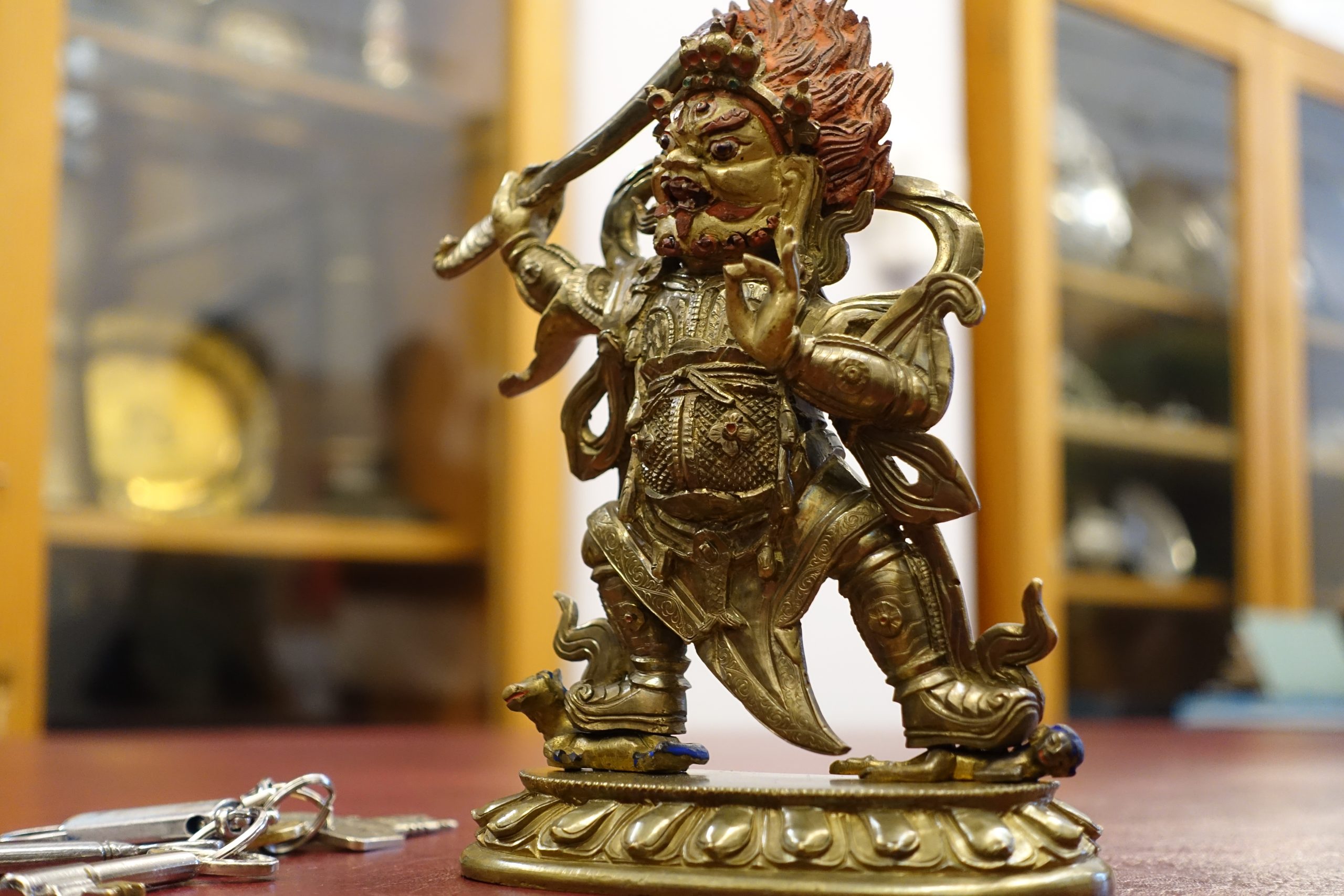
Begtse (front), Photograph © Gerald Kozicz, 2023
The tilted handle is actually a scorpion. The flaming scorpion sword is an iconoraphic element unique to Begtse. This deity goes back to various Tibetan Buddhist traditions but became particularly important and also popular in Mongolia as the God of War. It is thus no surprise to find him among other deities of Northern Buddhism. Like most of the other figures, the sculpture can be dated to the Qing Dynasty and roughly contemporaneous with the Vajrabhairava (2nd half of the 18th century) and the Vajrapani who – just for comparison – is depicted right in front of Vajrabhairava on the photograph. Begtse‘s left hand is placed right in front of his chest performing the gesture of debating. The little finger is extened and pointing upwards. It is not clear if he holds a round element in this hand. If so, it is a heart of an enemy of Buddhism. Usually, Begtse‘s feet would be placed on a horse and a male corpse on a lotus pedestal. It is not clear whether these elements are absent here or just not visible because of the perspective. The God of War is clad in an armour which is why h is also known as the Copper Nail Coat. A garland of severed demon heads frames his pott-bellied waist.
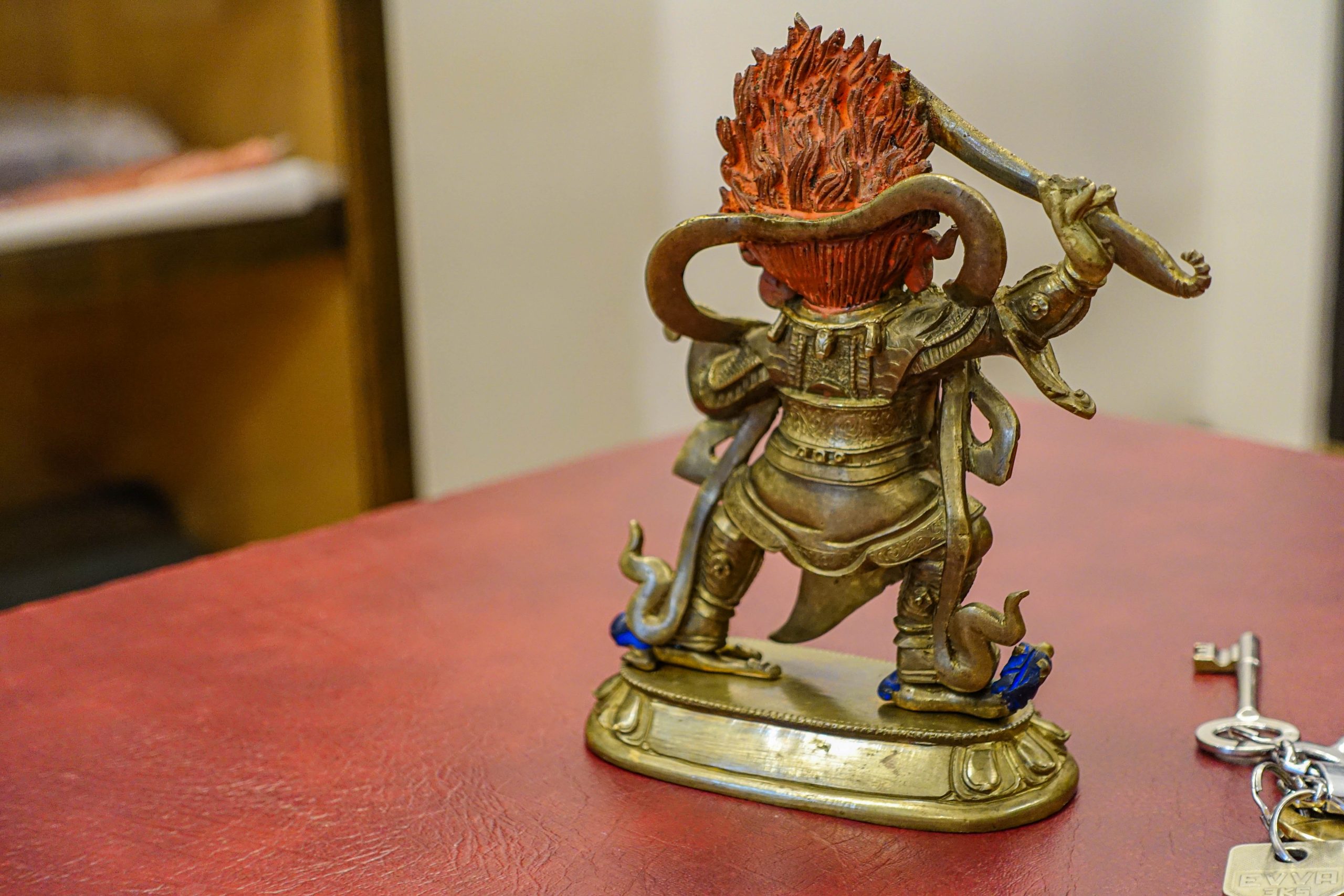
Begtse (back), Photograph © Gerald Kozicz, 2023
This sculpture is no more part of the collection. When and under which circumstances it was separated from the assembly is not known. The popularity of Begtse in Mongolian Buddhismus and also among other cultures of the Northern steppes naturally resulted in a large number of chasted sculptures. The sculpture on the dresser of the Skušeks is not the only sculpture of Begtse from the Qing Dynasty which found its way into a European collections. A very simlar specimen – complete with horse and male corpse on a lotus pedestal below – is in the collection of the National Museum Warsaw. One may easily guess that a deity trampling on (and thereby controling) a horse and a male was visually very appealing to the patriarchial system of an equestarian nomadic culture that expanded their power all across Asia, and that Begtse easily qualified as a God of War. (https://cyfrowe.mnw.art.pl/en/catalog/507145)
Turntable of the Begtse from the Warsaw collection including visual representation of his sword, Visualisation and Animation by Max Frühwirt, Drawings by Gerald Kozicz © 2025
For the reconstruction of the original configuration we employ the 3D-model of the Begtse from the Warsaw collection as a substitude for the lost figure. It adds to the strong presence of the wrathful images of the original set. although the figure is not original, it allows us to reconstruct the original impact of the assembled Buddhist gods.