Documenting the development of an interactive web environment: First steps
Text by Max Frühwirt
The main purpose of this weeks blog post is to introduce “A website in motion”. This new format of inter-connected blog-posts, which will be expanded upon as development continues, serves a simple purpose: Shedding light on the development of the web-environment aspects of the immersive experience while also acting as a guideline to exploration of the page.

First version of the website and its linear progression, Illustration © Max Frühwirt 2025
The first version of the website, while sufficient as a “work in progress” to showcase introductory information about both the ongoing research project and the Skušek Collection, presented some fundamental issues when it came to incorporating the envisioned immersive experience.
The limitation of encapsulating the project’s complete homepage, including introduction to the project, its background and additional details, within its landing page, creating a single home for the project, a home-page, so to speak, and an additional sub-page allowed for way too narrow an experience. This initial home-page, which was the first things visitors would see, was far too limited in its approach, as it was favouring a direct and very linear navigation between pages, without any cross referencing, which would not allow for the incorporation of explorative aspects planned for the final experience. On the other hand, it also lacked clear structure, bluring the lines between different topics, fields of research and findings about both the the Skušeks and their collection. This would make later differentiation into different fields of interest that the visitors may want to explore difficult and lead to the landing page feeling cluttered and overloaded.

Second version of the website and its more interconnected approach, Illustration © Max Frühwirt 2025
It was thus decided to break up the existing homepage into multiple smaller and more easily digestible sub-pages. Thereby, the landing page was intended to again become something of a returning point for people, to start different explorations from, another type of home-page so to speak. It also serves as a first introduction to the project. To allow visitors a deeper understanding of the different project aspects, a timeline was added to the landing page to document important developments and key figures. The exhibition of the SEM collection meanwhile, previously split up and mixed with other topics, was clearly seperated into two pages documenting both its contents and its technical aspects. Moreover, cross referencing between both the existing pages as well as additional outside material via hyperlinks was added, adding room for exploration. Last but not least, the Immersive Experience section and blog-archive was introduced. This ever growing archive is designed to both allow the user to understand and retrace the steps, that led up to the final presentation and be selective in their exploration, focusing on personal interests rather than general information.
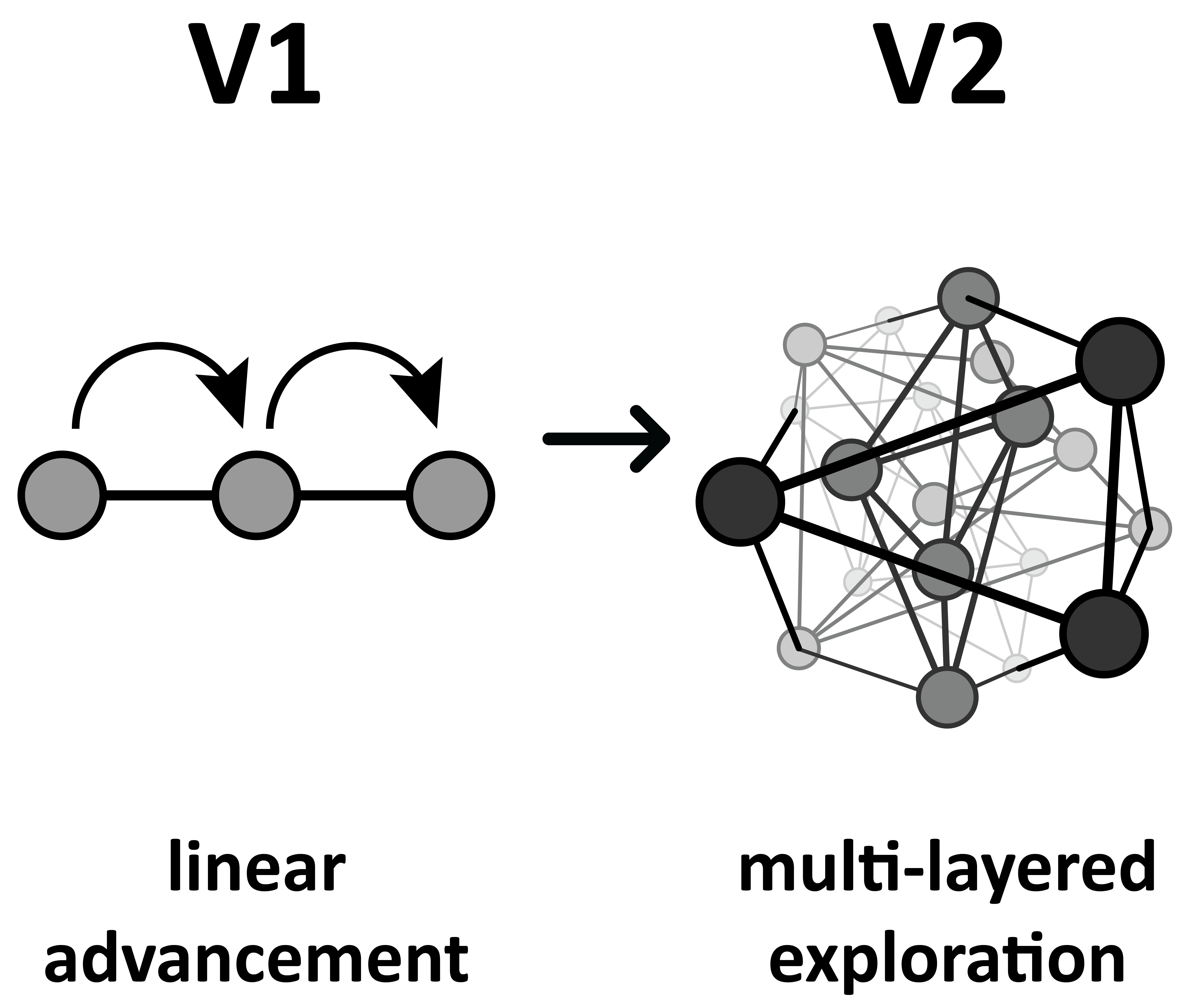
Illustration of the envisioned change over time, Illustration © Max Frühwirt 2025
Generally speaking, the implemented changes lay the foundation and first step towards a more multi-layered web experience, that will allow for further cross referencing between different topics and pages in the future, being added and built upon as it grows. Doing so, it is intended to create a mesh of information that allows and emboldens exploration of different topics according to the users preference and interest rather than following a guided or linear approach. This is very much an intentional feature and first step towards the envisioned constructionist learning environment. How it may grow and transform over time and thus be used to both disseminate information and help the user retain knowledge will be covered in future blog posts.