On the arrangement of the sculptures on the dresser
Text by Gerald Kozicz
All documentations of the set of Buddhist figures on the dresser show the wrathful couple Vajrabhairava and Vajravetalī in the centre right, in front of the mirror. (see e.g. Motoh 2021: 132, figs. 10 and 11) Although the other sculptures are shown in changing positions, a certain pattern can be attested.
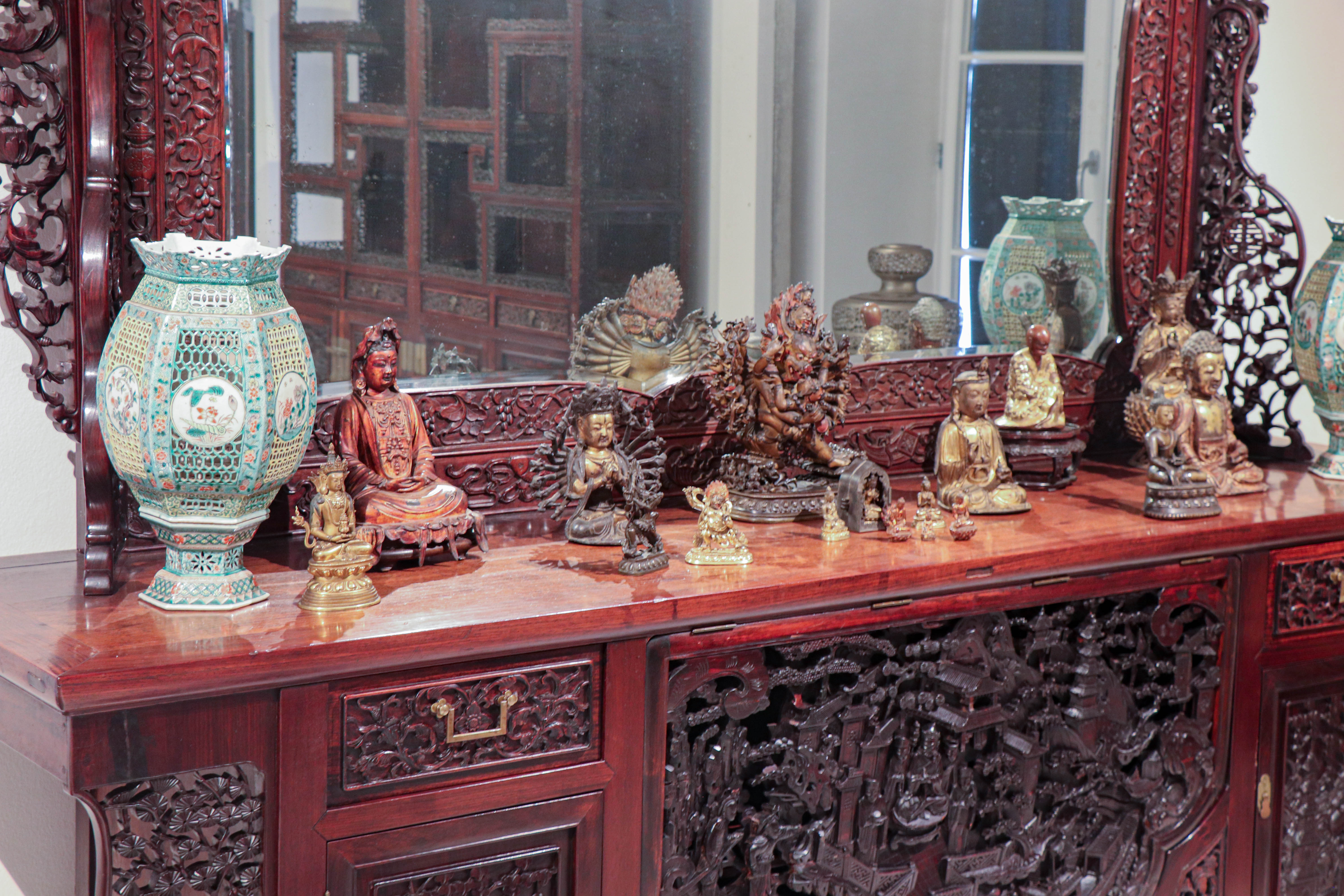
Close-up shot of the dresser displaying the sculptures during the 2025 exhibition “Asia in the Heart of Ljubljana: The Life of the Skušek Collection” at the Slovene Ethnographic Museum, Photograph © Max Frühwirt 2025
The central part of the dresser is dedicated primarily to the aggressive deities, while the peaceful deities are placed towards the periphery.
The contrast shows a clear preference for the wrathful figures, which are also the visually more impressive. The obvious contrast between wrathful and peaceful however, also reminds us that these two categories would hardly be arranged that way in their original socio-religious context, that is, in an orthodox monastic environment. Vajrabhairava would be the main deity inside a protectors‘ chapel (Tib. gönkhang), whereas Buddha would be the main deity in an assembly or prayer hall.
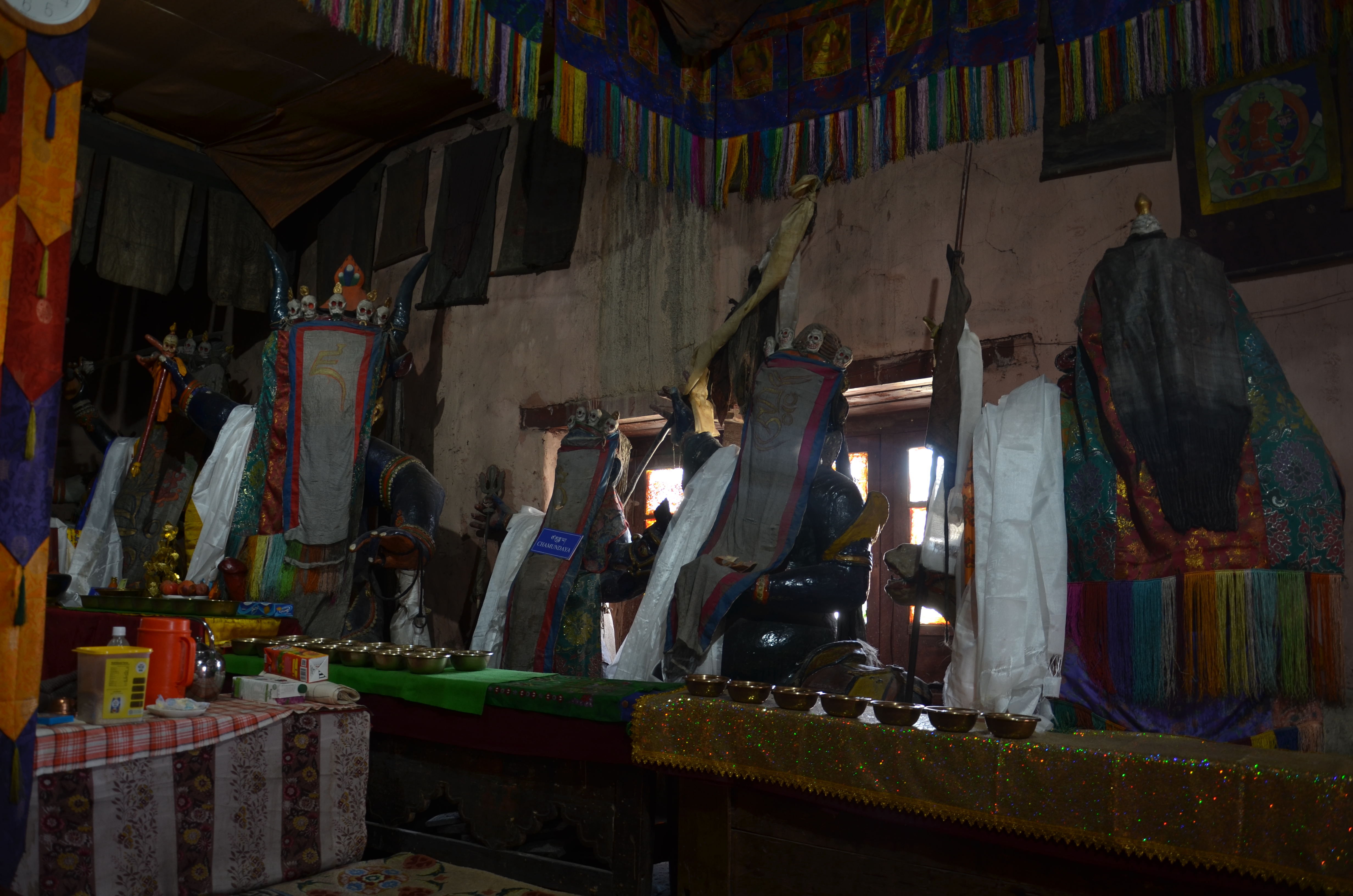
Protectors’ chapel (gönkhang) of the Diskit Monastery in Ladakh, India, Photograph © Gerald Kozicz 2019
Inside the gönkhang, the faces of the wrathful deities would be hidden behind scarves and only made visible to the public during festivals or special rituals (San. pūja) under the supervision of a high lama. Buddha would not be depicted inside a gönkhang.
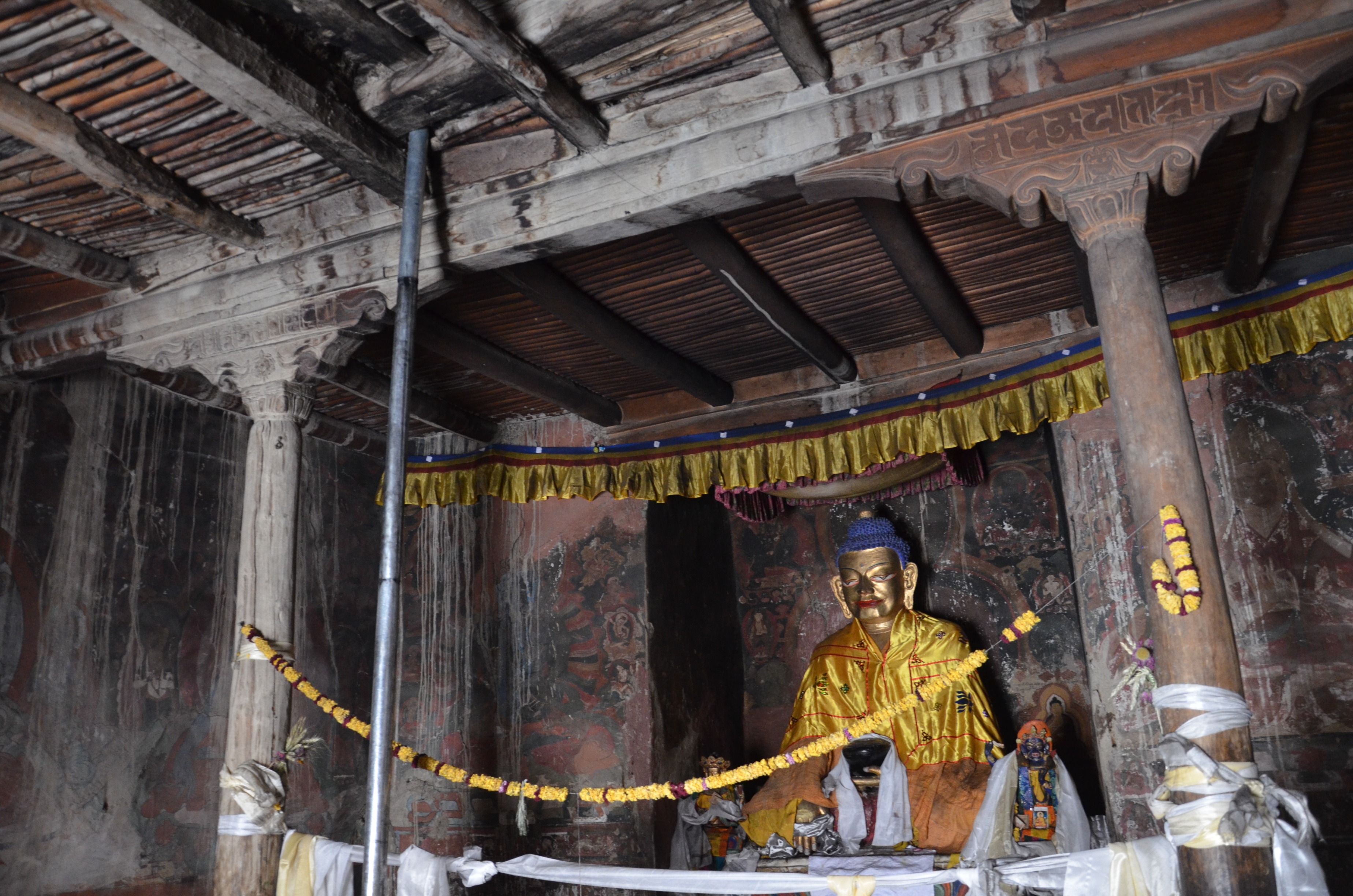
Buddha statue in the prayer hall of Hundar Monastery in Ladakh, India, Photograph © Gerald Kozicz 2014
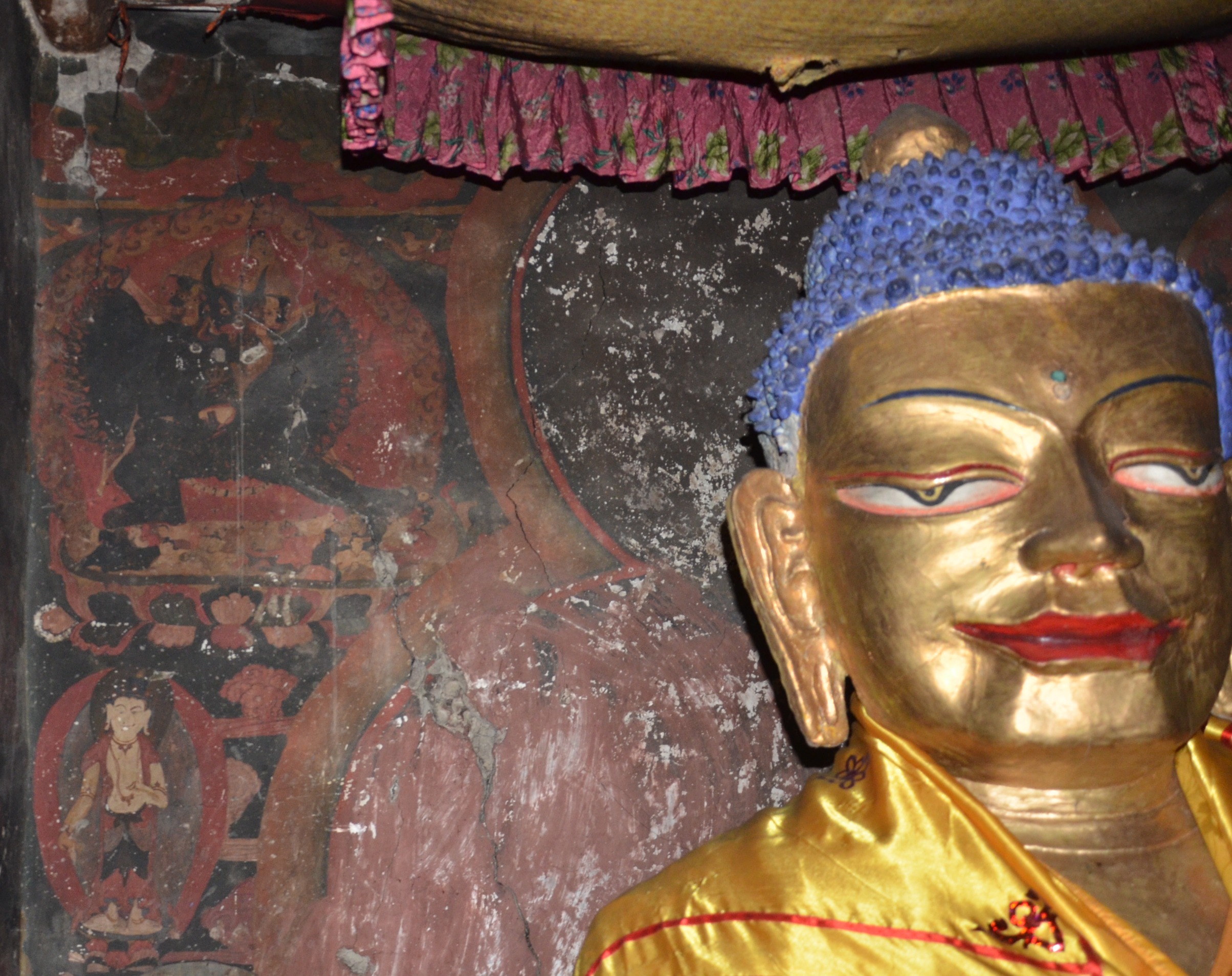
Vajrabhairava on the wall painting next to the Buddha of Hundar Monastery in Ladakh, India, Photograph © Gerald Kozicz 2014
If Vajrabhairava would be shown inside a prayer hall, he would be sub-ordinate to Buddha. (Kozicz and Luo 2025: 47, fig. 10) Thus, on first sight, the constellation on the dresser in the private room of the Skušeks appears like a violation of some fundamental principles. We do, however, not know how private shrine rooms and altars were organised in Tibet and China. But we may still assume that certain rules concerning hierarchy and meaning of order pertained.
This is a deviation from the established practise and another aspect we may add to the multi-layered question regarding the intention behind the chosen mode of presentation of the images on the dresser.
References
Kozicz, Gerald and Di Luo (2024) ‘The Adamantine Terrifier on the Dresser’, Poligrafi Vol. 29 no. 115/116: 141–66. Open access URL https://ojs.zrs-kp.si/index.php/poligrafi/article/view/441/490.
Motoh, Helena (2021) ‘Lived-in Museum: The Early 20th Century Skušek Collection’, Asian Studies 9, no. 3: 119–140. Open access URL https://journals.uni-lj.si/as/issue/view/739.