Visual Wrath
Text by Gerald Kozicz
The nine-headed Vajrabhairava in embrace with his wisdom partner Vajravetalī are among the most complex single imagery in Buddhism. Together they have 36 arms each of which holds a different attribute (except the two held by the female which also appear in the hands of the male) and eight plus one pair of legs – not to talk about the animals and Brahmanic deities they tramble on. Each attribute or weapon symbolises transcendental wisdom and the means to overcome obstacles along the path towards enlightenment.
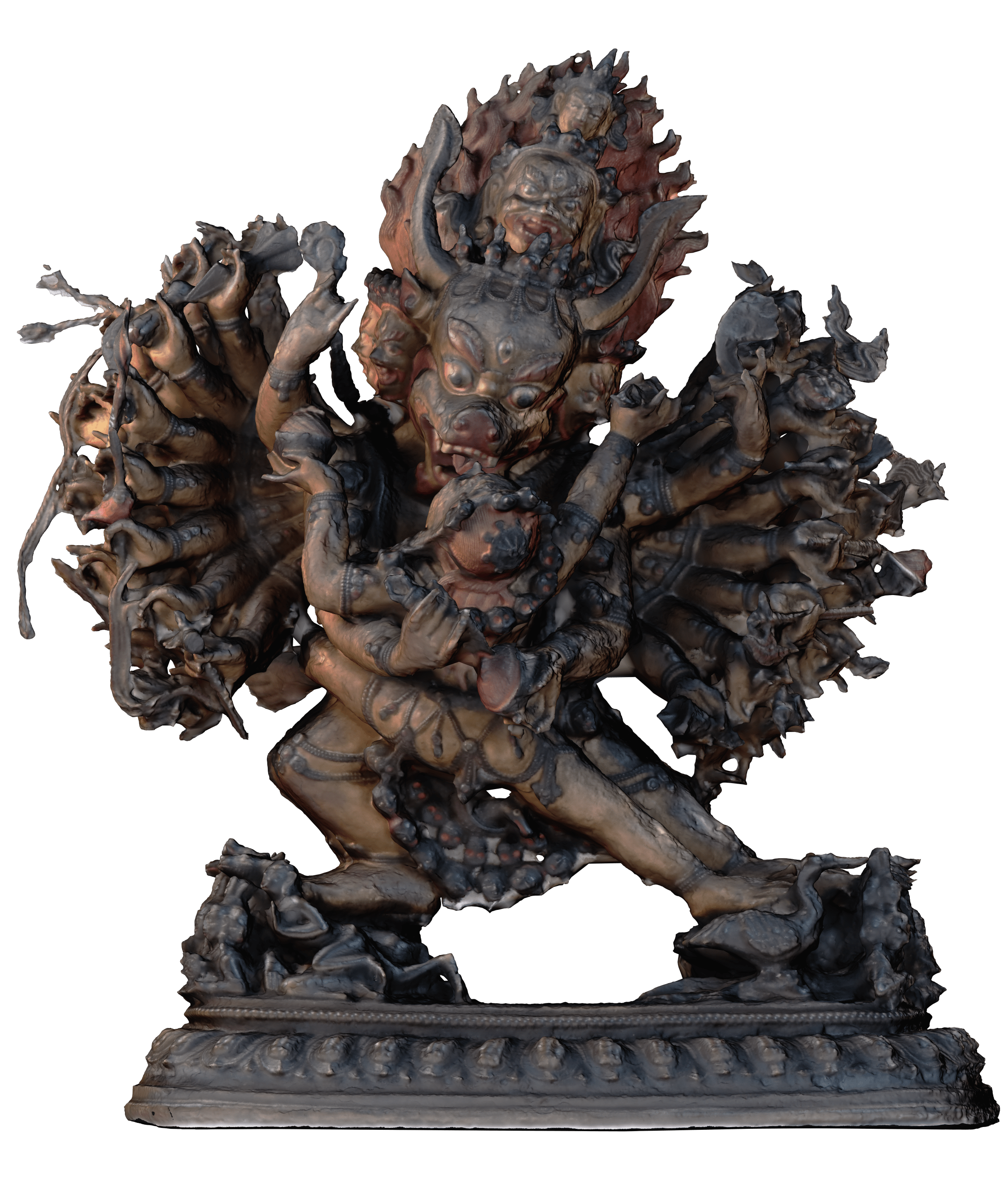
Frontal view of the digital Vajrabhairava, Visualisation © Max Frühwirt, 2024
The couple – as a unit symbolized by the embrace (yab-yum) – is among the three highest meditational deities of the Gelug Order of Tibetan Buddhism. Since the Gelugpa provided spiritual guidance to the Manchu Emperors of the Qing Dynasty, Vajrabhairava had a special status because of the extreme wrath that he radiated and was even considered one of their gods of war. Despite his wrathful appearance he is considered an emanation of the Bodhisattva of Wisdom, Mañjuśrī whose benevolent looking head is on top of the nine.
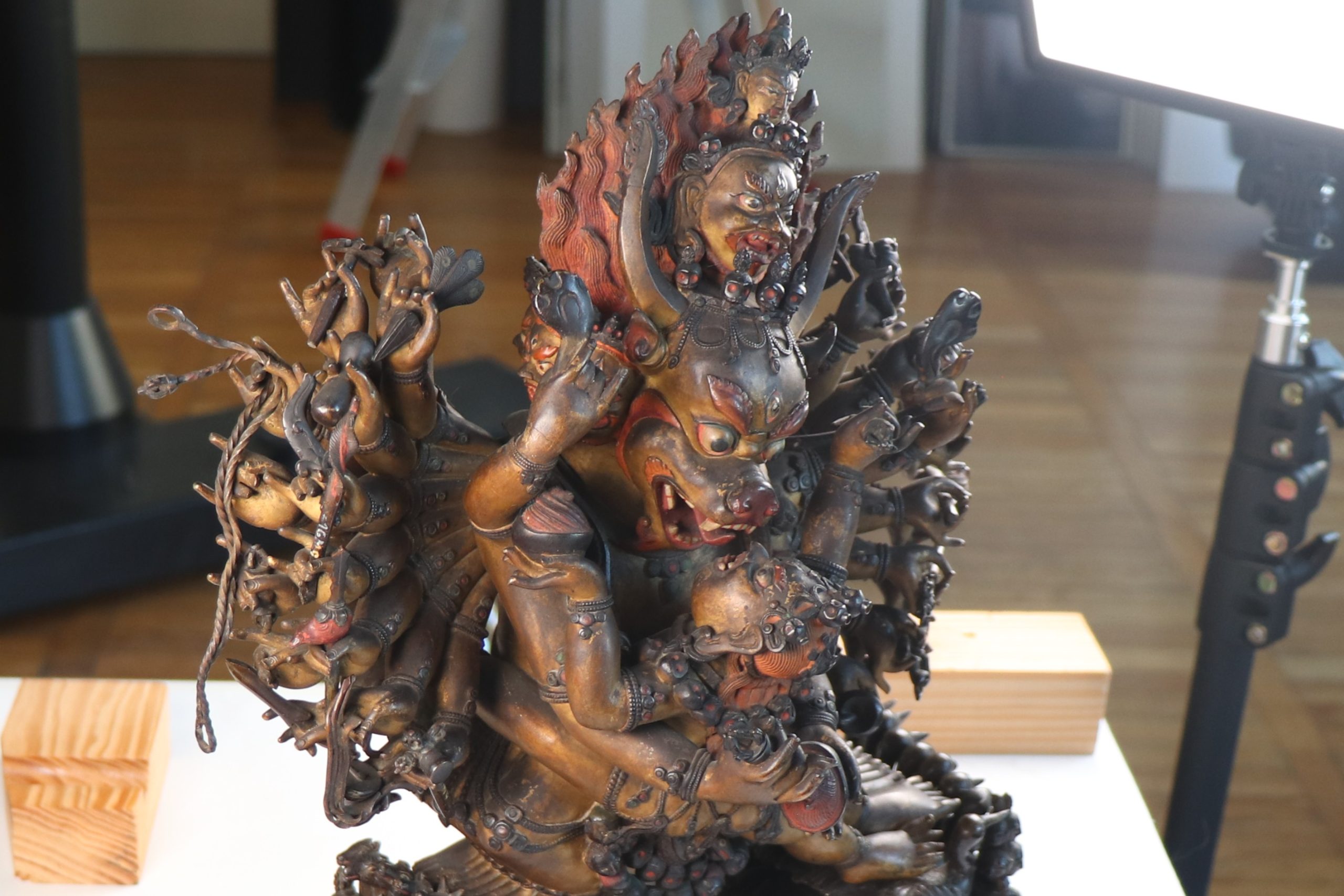
Vajrabhairava and their partner, Photograph © Max Frühwirt, 2024
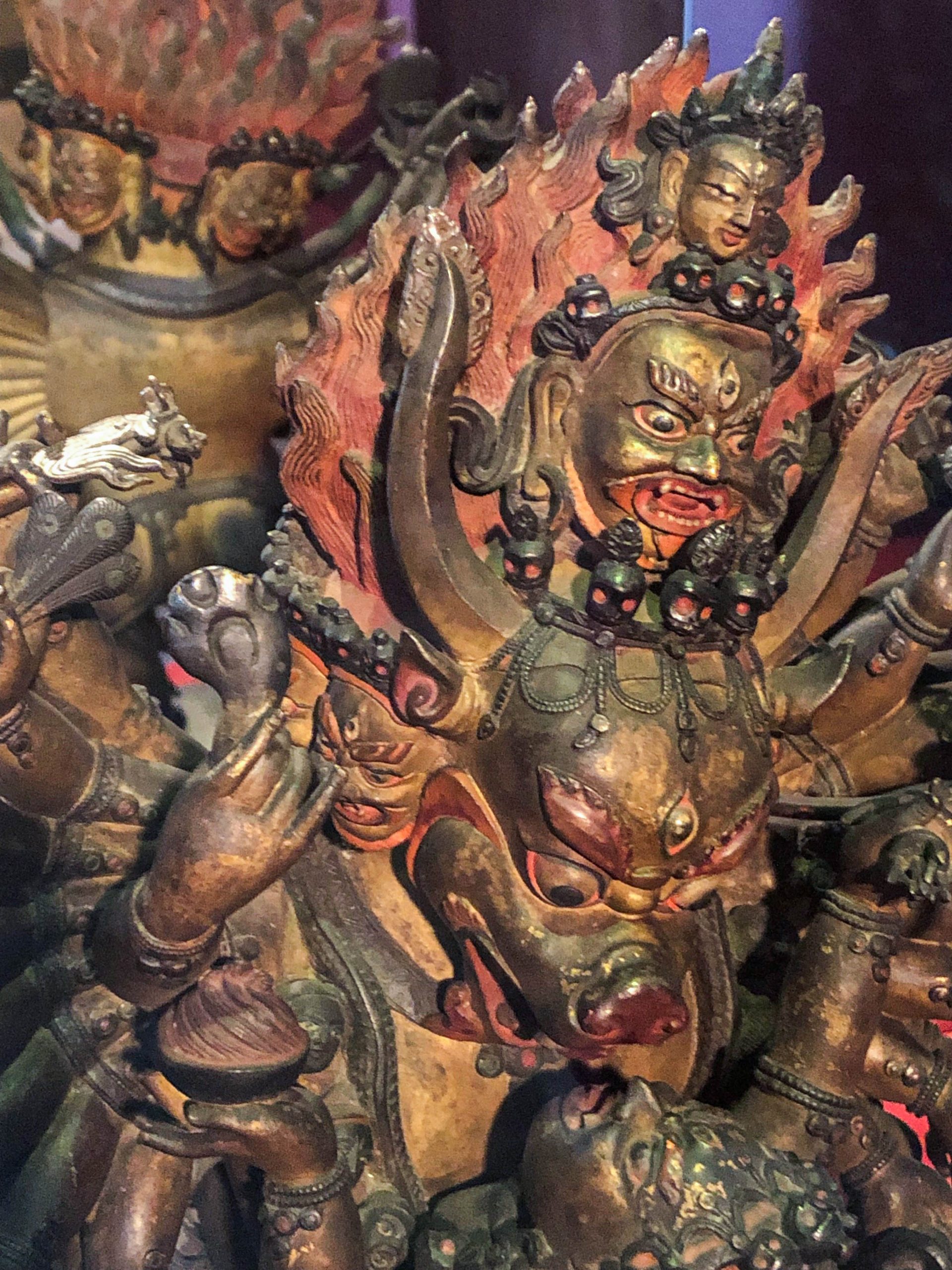
Close-up of Vajrabhairava and their partner, Photograph © Gerald Kozicz, 2024
The method of overcoming obstructions – both external and internal – through wrath is at the core of Tantric practice. In visual art the potency and effectiveness of a deity is not only expressed by facial features such as red, protruding eyes, fangs and the third eye, or skull crown and flaming hair. Even more distinctive and specific regarding the approach taken by meditating on a certain deity are the attributes held in their hands. Having this in mind one can easily understand the power of the practice of the Vajrabhairava Tantra. The image is thus only a guideline that provides the visual support.
With a total of 36 arms however, it was very difficult for the artists to include all the weapons in the image. It was challenging in drawing and painting, but even more in sculpture. In sculpture, the many arms required two circles of arayed arms for the male: two embracing Vajravetalī, and two arays of eight arms on each side. As a consequence, there is hardly any sculpture where all the attributes can be seen clearly. To visualize the totality of weapons and their particular meaning, we employ the annotated 3D-model combined with drawings of the individual icons.
Flyaround of Vajrabhairava including visual representation of his symbols, Visualisation and Animation by Max Frühwirt, Drawings by Gerald Kozicz © 2025
References
Beer, Robert (2003) The Handbook of Buddhist Symbols. Chicago – London: Serindia.
Chandra, Lokesh (2000) Dictionary of Buddhist Iconography, Vol. 2, 506-508. New Delhi: International Academy for Indian Culture.