Technology I
Text by Gerald Kozicz
Trying to grasp its complexity, one may easily forget about the skills and technology that were necessary to create such an image. The sculpture was most likely crafted in an imperial workshop in Beijing during the reign of Emperor Qianlong. The usual technology applied for metal works was the lost wax casting.The single components were first modelled in wax and then covred with layers of clay. Once dried, the clay was burned and the melting wax left the cavity which could then be used for the casting of the metal. Every cast could be used only once which means for every component a new cast had to be produced. Afterwards, the single pieces were assembled. Armlets and other bands could be wrapped around to cover the joints.
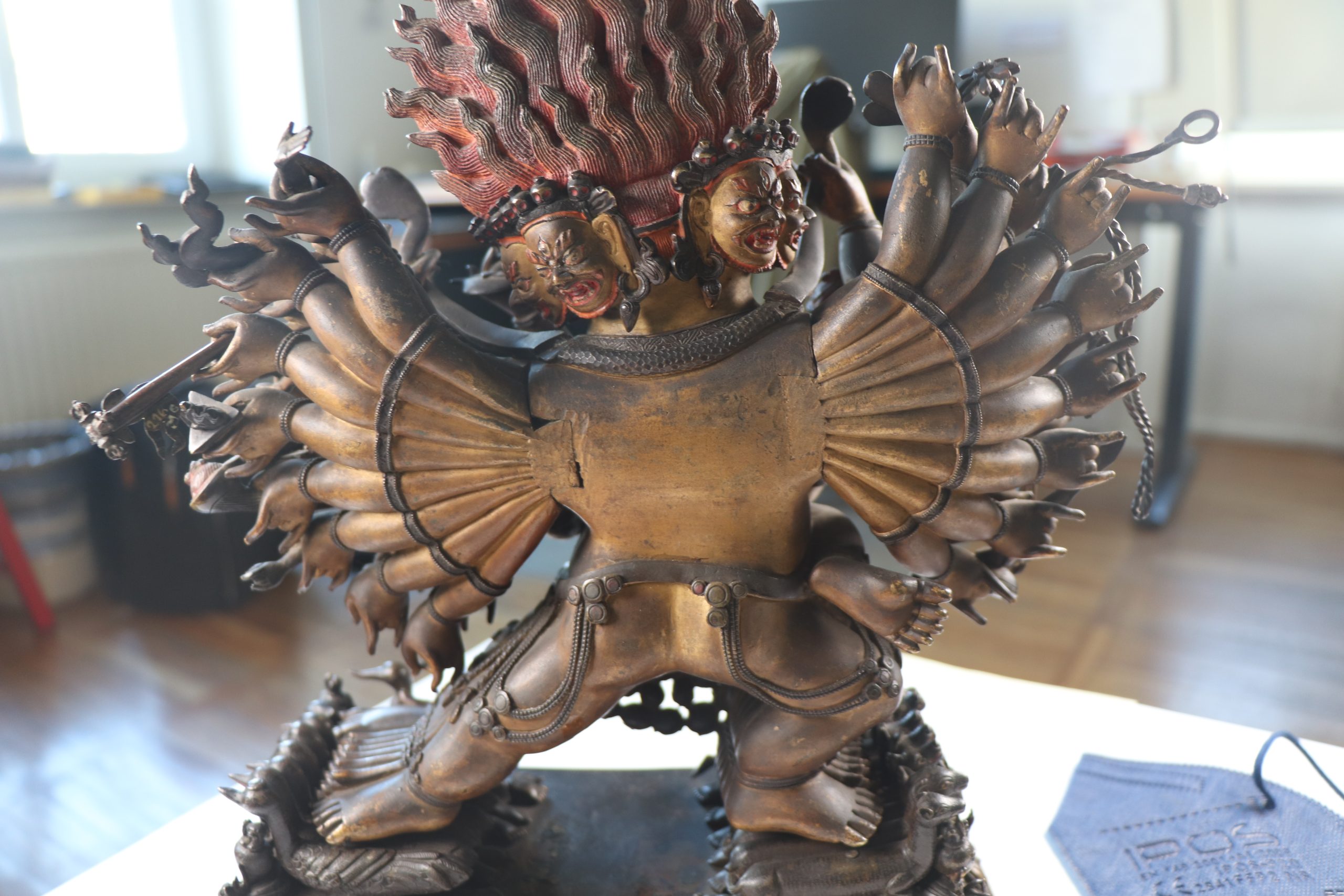
Back view of the Vajrabhairava sculpture showing the seperately cast and later connected arms, Photograph © Max Frühwirt, 2024
The backside of the sculpture where all the arms would connect to the torso could easily be hidden behind the elephant skin which is a common attribute of most of the wrathful Tantric deities. In our case the loss of the elephant skin allows an inspection of this major joint.
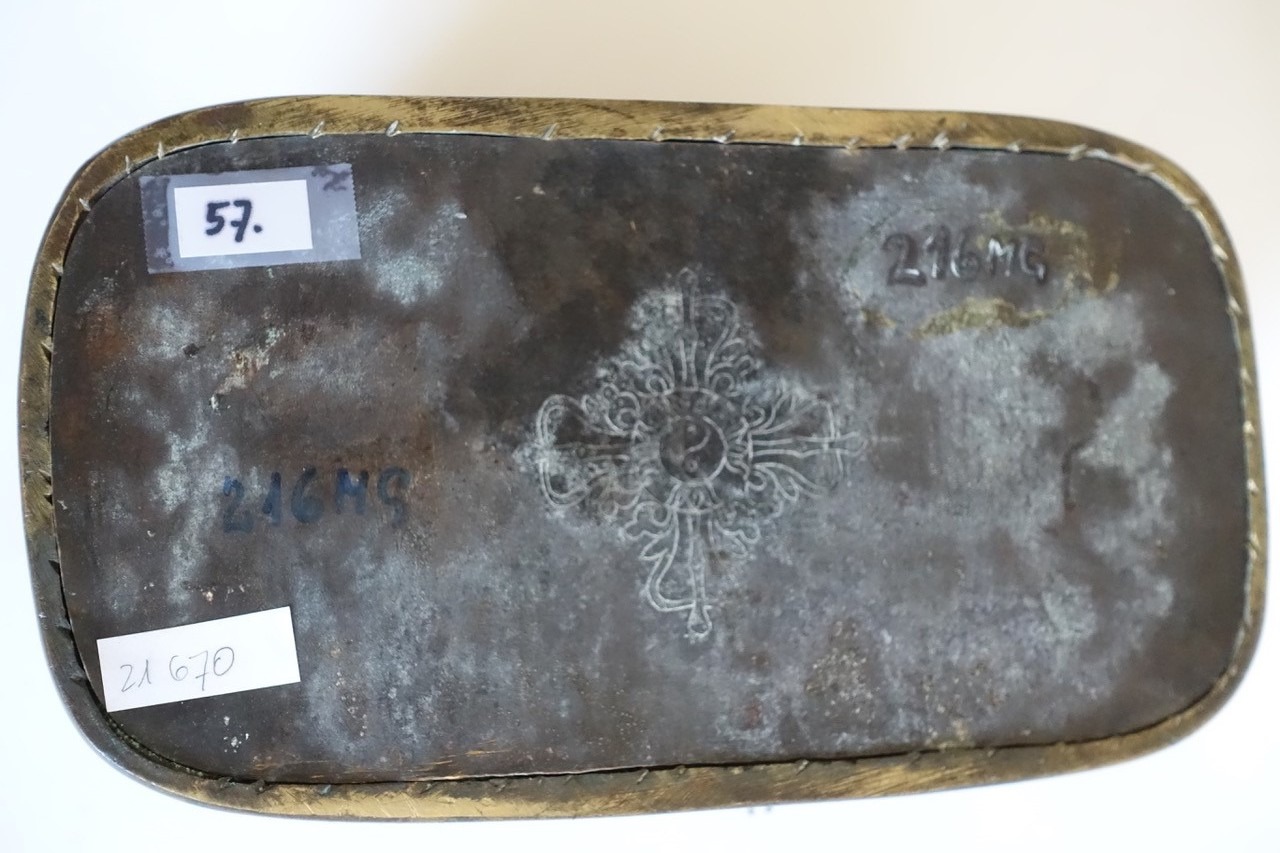
Symbol engraved at the bottom of the sculpture, Photograph © Max Frühwirt, 2024
Most of the attributes were cast separately, too, and then placed in the respective hands. They were sometimes only stuck into the hands but not glued. As a consequence, a couple of attributes and weapons went missing in our case, or fell out of their original position and were placed in the wrong hands.
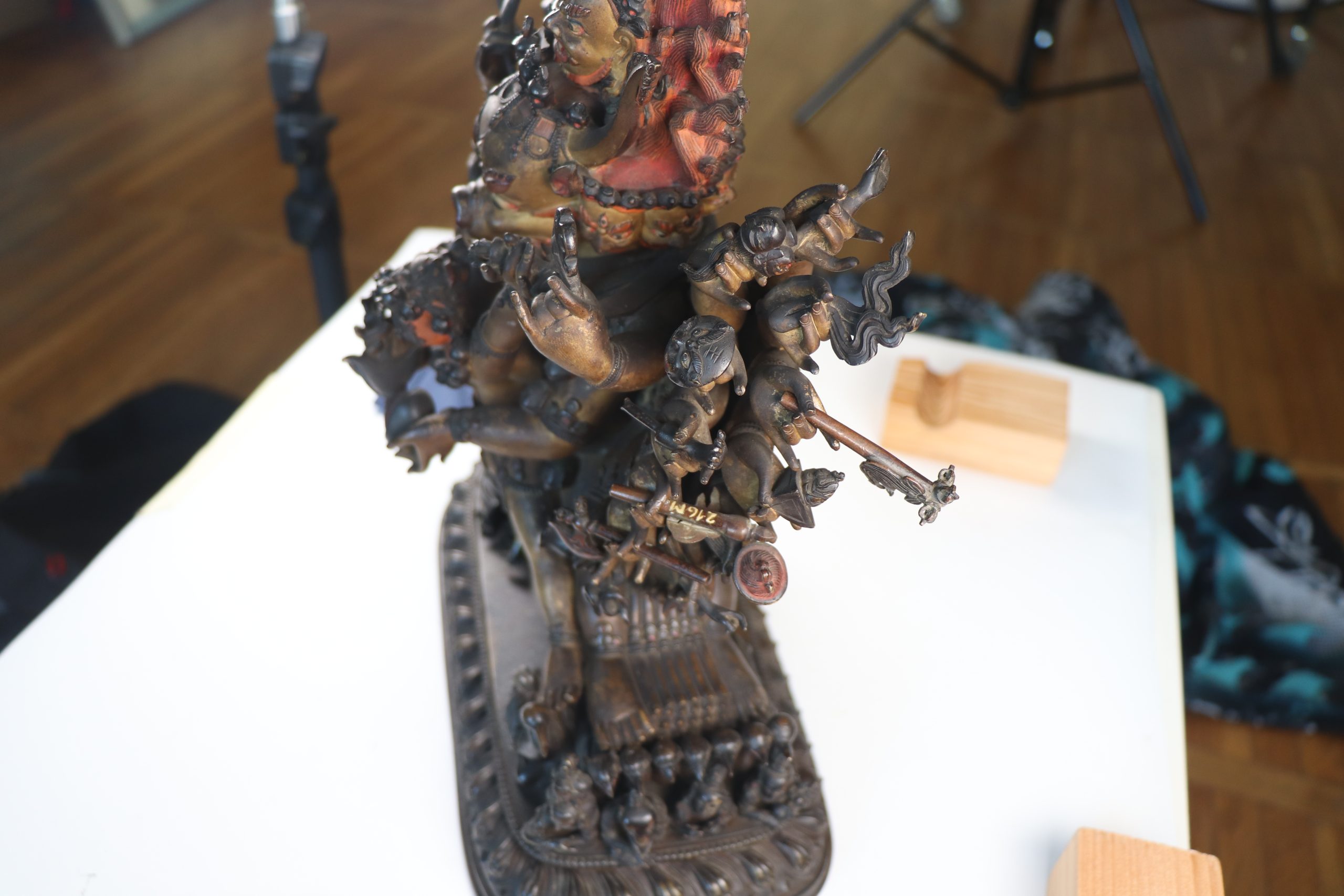
Close-up of the left side, showing the attributes as they were placed at the time of recording, Photograph © Max Frühwirt, 2024
In painting, the couple is dark-blue or black. In gilded metalworks, only the red, orange and white parts are in clour, that is, hair, eyes, mouth and flames, beard, and eyes and teeth. Thin lines of blue can also be detected around the eyes. To notice such detail however, one has to get very close to it. In a museum it is usuall impossible to get that close to an object. In this case we use the interactive 3D-model to explain the technology of assembling the single elemenst into one piece but also to zoom into these details and make the fine craftsmenship perceivable.
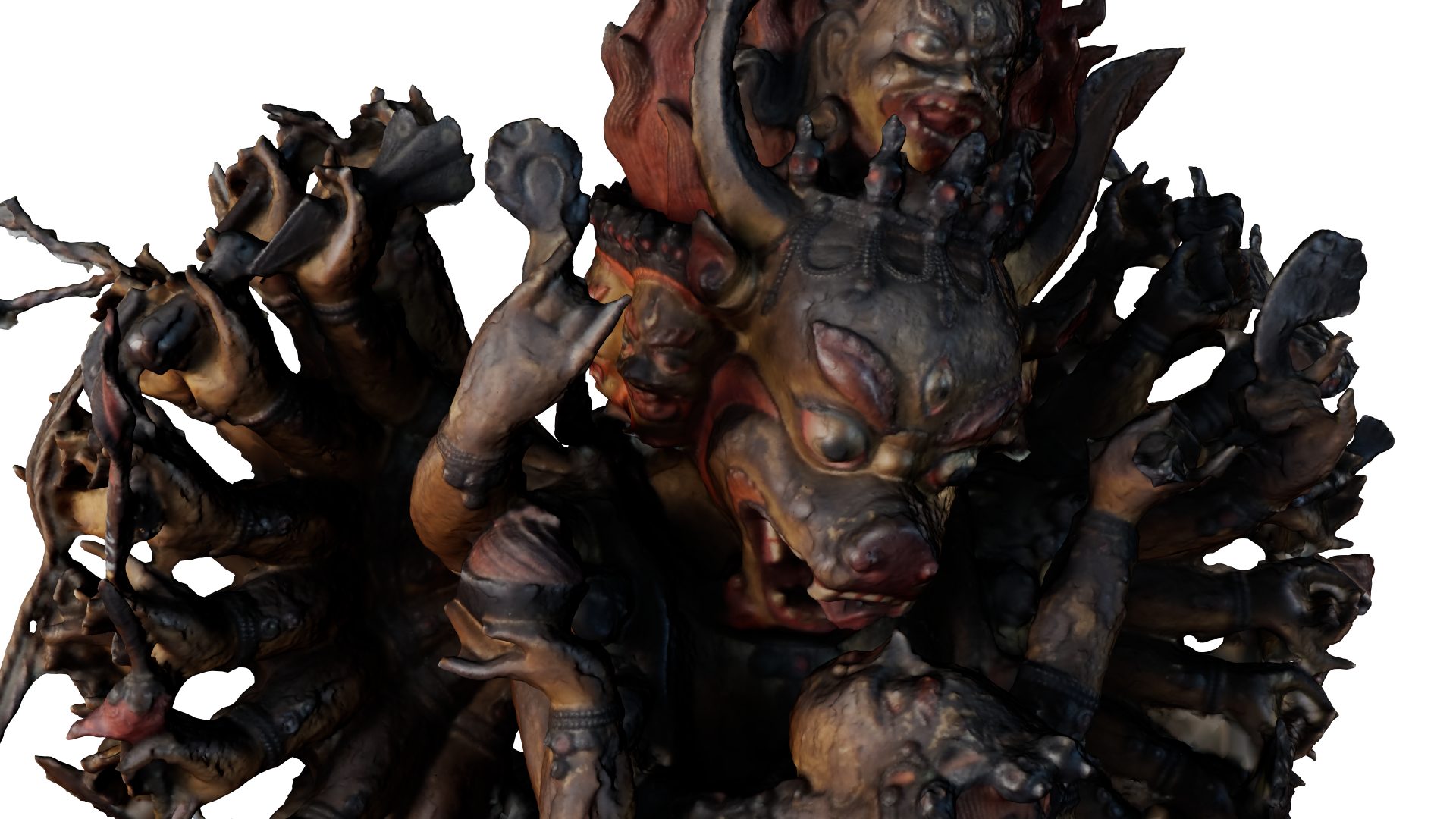
Close-up of the scanned 3D model of the Vajrabhairava, Visualisation © Max Frühwirt, 2024
References
Beer, Robert (2003) The Handbook of Buddhist Symbols. Chicago – London: Serindia.
Chandra, Lokesh (2000) Dictionary of Buddhist Iconography, Vol. 2, 506-508. New Delhi: International Academy for Indian Culture.