The Buddhist Master
Text by Gerald Kozicz
Among the sculptures on the dresser is also one wood-carved image of a Buddhist teacher placed on a wooden round seat. The wood is dark-brown and polished, the facial details extremely refined. The only colour is the gilding of the robe which brings to the foreground the broad border and the ornamental design.
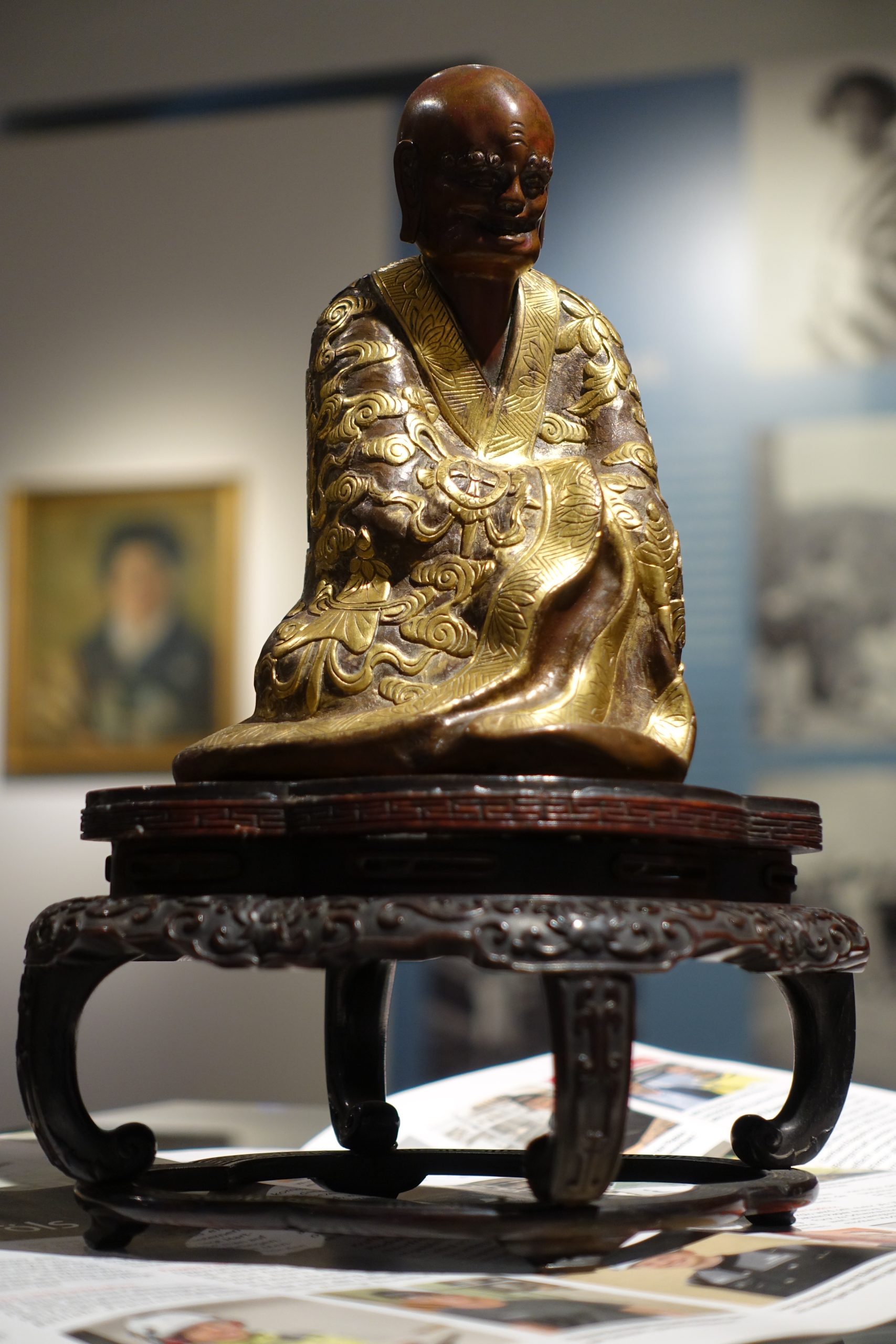
Buddhist master sculpture that was displayed on the dresser, Photograph © Gerald Kozicz, 2024
The master is seated and and is completely coated by this single textile like by a cocoon. One can only guess that he has his hands in the position of meditation on his lap. The hand gesture which is ususally crucial for the “reading” of the iconography of a figure is thereby hidden. All we see are the head and the robe.
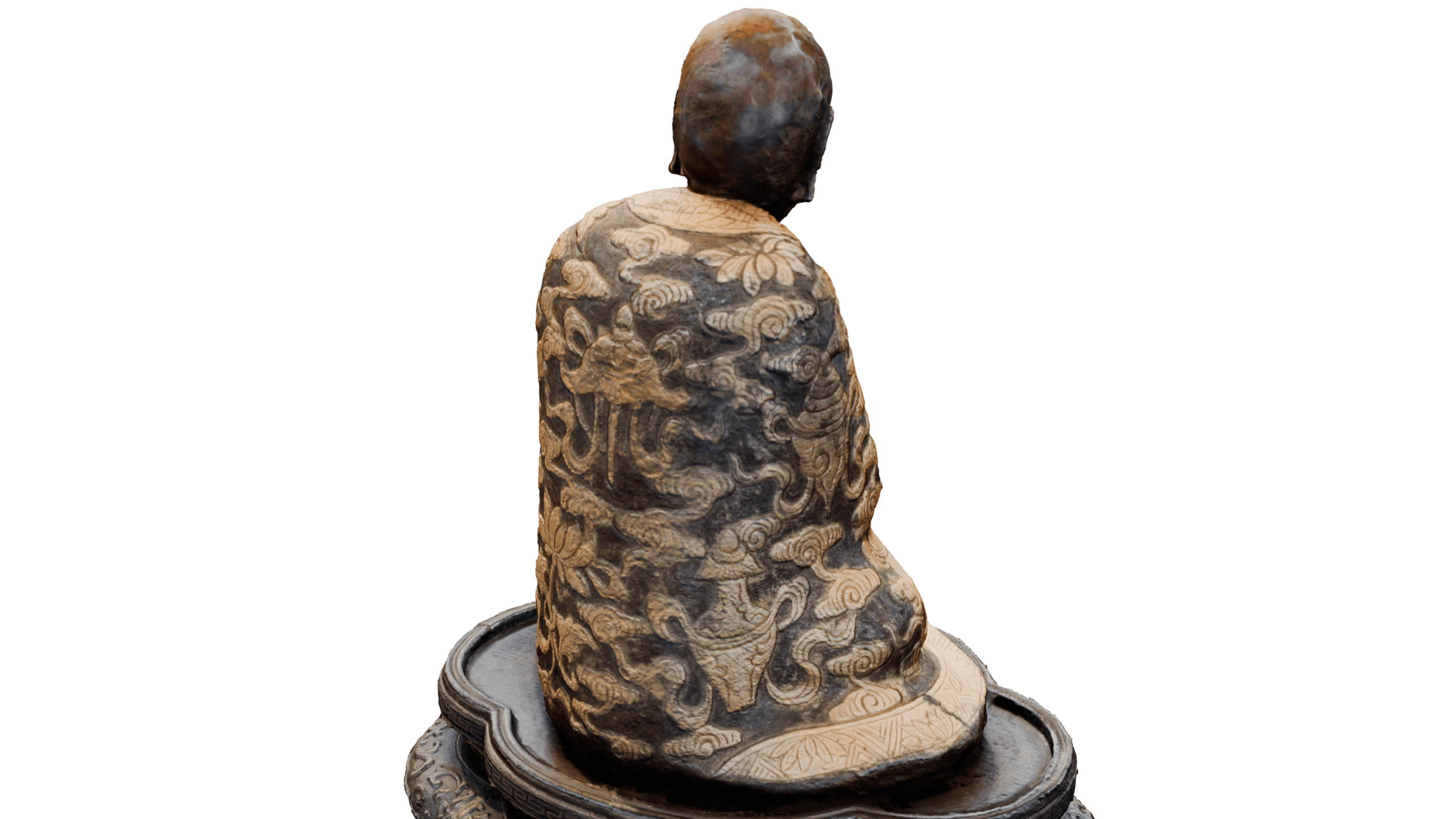
Close-up of some of the symbols on the robe, Visualisation © Max Frühwirt, 2025
The visual information thus is indeed on the robe. Among the cloud-like spirals we find the Eight Symbols of Buddhism (thereby leaving no doubt that we face a Buddhist master and not a Confucian or Daoist). If we move around the figure in a clokewise order we first have the Dharmacakra, the Wheel of the Law at the hight of the right arm. The Dharma Wheel usually has eight spokes. Here we only have four which strangely reminds on a Christian cross rather than the Buddhist symbol. If we look closely we notice that every spoke is made of two components. Thus, we in fact have eight altogether. The victory banner is right below. Behind the right arm, the conch-shell is interwoven with the ornament. Below, follows the vase. Centrally on the back is the parasol. The parasol is also the symbol of the ruler of the world, the cakravartin, and thus for the Buddha. In stupa architecture, the parasol that is centrally placed on top, has a cosmic notion as the pole or staff is considered the axis mundi. Very often, sculptures of Buddhist sculptures depict deities under a parasol which would be placed right behind them. The choice of this position on the back of the teacher resonates of that context. Using the spine as the axis of symmetry, the lotus flower mirrors the vase. At the height of the left ellbow a fish is depicted in front of a staff. This is a deviation from the standardised iconography which prescibes the pair of fish. On the left shoulder, another lotus flower emerges from the border of the coat. It is visually almost completely absorbed by the ornamental pattern. Below follows the endless knot and finally – in mirroring the Dharmacakra – there is another conch-shell. This shell is more refined than the one behind the right arm while the flower on the shoulder seems less impactful than the flower on the back. Why two of the symbols are depicted twice is hard to tell. We presume they weree used as space fillers.
Flyaround of the Buddhist master including visual representation of the symbols on his robe, Visualisation and Animation by Max Frühwirt, Drawings by Gerald Kozicz © 2025
To sum up, the master is clad in the Eight Symbols of the Faith. This is significant as it reminds on the understanding of the master as the representative of the Buddha – or rather the representation of the Buddhist teaching. In Tibetan stupa architecture the Eight Smboly are sometimes depicted along the plinth of the monument. The stupa itself is considered the architectural representation of Buddhist Teaching, too.
The teaching is handed down from master to student who then becomes the master himself. The lineage as it is termed in context of Tibetan Buddhism where this concept was established from the 12th century onwards, is crucial in Tantric Buddhism. The master represents the essence of the doctrine.
References
Beer, Robert (2003) The Handbook of Buddhist Symbols, 1-15. Chicago – London: Serindia